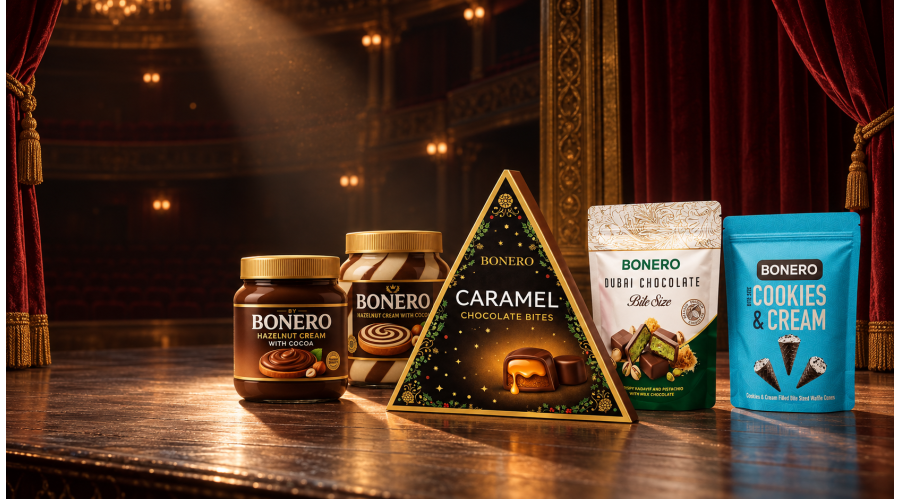
Chocolate Spread Packaging: Jar Sizes, Formats and Retail Positioning
Jar size decides more about a chocolate spread's success than the recipe does. The same hazelnut-cocoa cream sells as a 350 g glass jar in a Gulf supermarket, a 750 g PET jar in a West African wholesale market and a 1 kg bucket to a bakery in Central Asia. This guide sets out the formats Aprichem produces, where each one sells, and what to check on cartons, pallets and labels before you confirm an order.
The four packaging families
Chocolate and hazelnut spreads reach the market in four formats, and most importers end up carrying two of them:
- Retail jars, 200–400 g. Glass or PET with a metal or plastic lid and an induction seal. This is the supermarket shelf standard; 350 g and 400 g are the most common sizes in the Middle East and Europe, 200–250 g for premium or nut-based spreads such as our Bonero pistachio cream spread 250 g.
- Family and value jars, 600–1000 g. Usually PET to save weight and breakage. The 750 g jar is the volume format for traditional trade in Africa, Iraq and Central Asia – see Bonero hazelnut cream with cocoa 750 g.
- Foodservice and industrial, 1–5 kg. PP buckets with a tamper-evident lid for bakeries, hotels, crêpe and waffle shops. Sold by the pallet, often under the buyer's own label.
- Portion packs, 15–25 g. Cups or sachets for hotels, airlines, school meals and cereal bundles. Low per-unit weight, high per-kilo price.
Duo spreads – two colours in one jar – and crunchy variants (biscuit or wafer pieces) use the same jar sizes but carry a higher shelf price; see Bonero duo spread 350 g and Bonero biscuit crunchy spread.
Which size sells in which market
| Market | Leading retail size | Second size | Notes |
|---|---|---|---|
| Gulf (UAE, Saudi, Kuwait) | 350–400 g glass | 750 g PET | Glass expected on supermarket shelf; Arabic label mandatory |
| Iraq, Jordan, Lebanon | 350 g | 750 g / 1 kg | Price-driven; PET accepted |
| West Africa (Nigeria, Ghana, Senegal) | 750 g PET | 350 g | Sold by the carton in open markets; PET avoids breakage |
| North Africa | 350 g | 750 g | French/Arabic bilingual label |
| Central Asia, Caucasus | 350 g | 1 kg bucket (foodservice) | Russian label; EAC marking for EAEU countries |
| Latin America | 200–350 g | – | Spanish label; smaller jars, higher per-kilo price |
A first order normally combines one retail size and one value size rather than a full ladder. Add a third size only after sell-through data from the first two.
Glass or PET?
Glass signals quality and is expected by chain supermarkets; it costs more, weighs roughly 40% more per pallet and needs more careful container loading. PET is lighter, unbreakable and standard for 750 g and above. Our rule of thumb: glass for 200–400 g jars going to chain retail, PET for anything over 500 g or for markets where the jar travels by truck after the port. Both take the same induction seal and the same label.
Cartons and pallets
- Retail jars: 12 × 350–400 g or 6 × 750 g per carton; ⟦…⟧ cartons per Euro pallet (confirm per SKU on the specification sheet).
- Buckets: 1 kg × 6 or 5 kg × 1–2 per carton, stacked ⟦…⟧ high.
- A 20 ft container carries roughly ⟦…⟧ pallets of 350 g jars or ⟦…⟧ t of spread in buckets; a 40 ft doubles the pallet count but the weight limit, not the volume, usually decides for buckets.
- Spread is temperature-sensitive: above 30 °C the oil phase separates in the jar. For summer shipments to the Gulf and West Africa we recommend loading early in the week, avoiding roof positions in the container and asking the forwarder for a non-exposed yard slot.
Labelling checklist
The label is the most common cause of delay at destination customs. Before artwork is approved, confirm:
- Product name and legal description ("hazelnut cream with cocoa", not "chocolate" if cocoa butter content does not qualify)
- Ingredient list in descending order, allergens in bold (hazelnut, milk, soy)
- Net weight, lot number and production/expiry date format required by the market
- Nutrition table in the destination format (GCC: per 100 g; EU: per 100 g plus portion)
- Language: Arabic for GCC, French for West/North Africa, Spanish for Latin America, Russian for EAEU
- Importer name and address, country of origin ("Product of Türkiye")
- Barcode (EAN-13 on the jar, ITF-14 on the carton)
For private label jars we send a label template with the mandatory fields already placed; your designer adds branding. See private label & OEM manufacturing.
Private label packaging options
Minimum runs differ by component. Printed labels on a stock jar are the quickest route – artwork to shelf in about ⟦8⟧ weeks. A custom jar shape or printed lid needs a mould or print cylinder and a larger minimum; a shrink sleeve sits between the two. Most importers start with a stock jar and a printed label, then move to custom components once volume justifies it.
Frequently asked questions
What is the shelf life of chocolate spread?
⟦12⟧ months from production in a sealed jar stored below 25 °C. Oil separation after exposure to heat is cosmetic and reversible by stirring, but we recommend keeping spread out of direct sun in the warehouse.
Can we mix jar sizes in one container?
Yes. Mixed pallets of 350 g and 750 g are standard, and spread can share a container with wafers, compound chocolate and powder drinks.
Which spread should a new importer start with?
A hazelnut-cocoa spread in the leading size for your market, plus one differentiator – a duo or crunchy spread, or a pistachio spread for the Gulf and Türkiye-aware markets. Our guide to building a spread range covers how to structure the shelf.
Request specification sheets, carton configurations and a quotation through the contact form; the export team replies within one business day.
Türkiye is the world's largest hazelnut producer, which is why hazelnut-cocoa spread made here is competitive on price and consistent on supply. This guide walks an importer or distributor through a spread sourcing project from the first enquiry to the first container: what to specify, what to ask the manufacturer for, which documents to expect, and how the cost builds up to a landed price.
1. Decide what you are actually buying
"Chocolate spread" covers several products with different cost structures:
- Hazelnut cream with cocoa – the mainstream product; hazelnut content typically 5–13%, price driven by the hazelnut share and the fat used.
- Cocoa spread – no or minimal nuts; the lowest-cost option for value markets.
- Duo spread – cocoa and milk (or hazelnut and white) swirled in one jar; a visual premium at a small cost increase. Example: Bonero duo spread 350 g.
- Crunchy spread – with biscuit, wafer or hazelnut pieces; example: Bonero biscuit crunchy spread.
- Pistachio spread – higher price point, strong in the Gulf and in the "Dubai chocolate" trend; example: Bonero pistachio cream spread 250 g. See also our pistachio spread sourcing guide.
- Foodservice spread – 1–5 kg buckets for bakeries and HoReCa, formulated to stay soft at room temperature.
Write down the role each product will play (everyday, value, premium, foodservice) before asking for prices; it stops you comparing a 13% hazelnut spread with a cocoa spread on price alone.
2. What to put in the enquiry
A quotation is only as good as the enquiry. Send the manufacturer:
- Destination country and sales channel (chain retail, wholesale/traditional trade, foodservice)
- Product type and target hazelnut content, or a benchmark product you want to match
- Jar size and material preference (see our packaging guide)
- Own brand or manufacturer brand; label languages
- Estimated annual volume and first-order size (pallets or containers)
- Delivery term you want priced: FOB Istanbul/Mersin, CIF or CFR your port
- Required certificates (Halal, ISO 22000, health certificate) and any registration the importer must file
With this information Aprichem returns a specification sheet, carton and pallet data, price per jar and per carton, and lead time, usually within one business day.
3. Samples and approval
Ask for retail samples of the exact SKU and, for private label, a lab sample made to your target recipe. Evaluate at room temperature and after a week at 30–35 °C – this shows whether the oil phase stays stable in your climate. Agree a "golden sample" in writing; production is then checked against it. For own-brand jars, approve the label proof against the labelling rules of your market before printing.
4. Documents you should expect
| Document | When | Purpose |
|---|---|---|
| Product specification sheet | With quotation | Ingredients, nutrition, shelf life, carton/pallet data |
| ISO 22000 / HACCP certificates | With quotation | Supplier approval, tenders |
| Halal certificate | With quotation / shipping docs | GCC, Pakistan, Malaysia, Indonesia, parts of Africa |
| Certificate of analysis | Per lot, on request | Microbiology, moisture, fat |
| Health certificate (Ministry of Agriculture and Forestry) | Shipping docs | Required by many African and Middle Eastern customs |
| Certificate of origin, packing list, invoice, bill of lading | Shipping docs | Customs clearance; preferential origin where trade agreements apply |
Our quality and food safety page lists the certificates Aprichem holds and the documents supplied with every order.
5. MOQ, lead time and payment
- Manufacturer brand (Bonero): ordered by full export carton; mixed-product containers with wafers, chocolate and powder drinks are routine, which lets a new importer fill a 20 ft without over-committing to one product.
- Private label: minimum set per project – driven by the printed label or sleeve run and the production batch size, not by the jar.
- Lead time: stock items ship within days of payment; private label after artwork approval plus label printing and a production slot. Exact dates are confirmed with the quotation.
- Payment: advance payment or letter of credit; terms are agreed with the quotation.
6. From FOB price to landed cost
Compare suppliers on landed cost per jar, not on FOB. Add to the FOB price:
- Sea freight and insurance to your port (CIF) – spread is heavy, so weight limits often fill before volume
- Import duty and VAT on CIF value (check the HS code for cocoa spreads, 1806 90, in your tariff)
- Port handling, customs broker, inland transport
- Label registration or product registration fees where applicable
- Breakage allowance for glass jars
Our guide on sourcing confectionery from Turkey vs China compares freight time and duty positions for the main destination regions.
Frequently asked questions
How long does shipping from Turkey take?
Roughly 1–2 weeks to Gulf ports, 2–3 weeks to East and North Africa, 3–4 weeks to West Africa, 3–5 weeks to Latin America, plus inland time. Spread ships in dry containers; reefers are not required if loading and storage avoid prolonged heat.
Can we start with one pallet?
Yes, as part of a mixed container or groupage shipment; a single-pallet LCL shipment is possible but freight per jar is high. Most first orders are a mixed 20 ft container.
Do you supply spread for private label only, or also under your brand?
Both. Importers often start with Bonero jars to test the market and move to their own label once volumes are known. See private label & OEM manufacturing and the full chocolate spread range.
To start, send your destination, channel and target products through the contact form; you will receive specifications and a quotation within one business day.
Seasonal chocolate is the most profitable and the most dangerous category an importer carries: margins are higher than everyday lines, but a gift box with a Christmas sleeve has no value on 27 December. Overstock comes from three mistakes – ordering too late and air-freighting, ordering too much on a single forecast, and buying packaging that cannot be sold outside the season. This guide gives a working calendar for the three main seasons served from Turkey and a method for sizing the order.
Count backwards from the shelf date
Work from the date the product must be on shelf, not the holiday itself. Retailers set seasonal displays 4–6 weeks before Christmas and Valentine's Day and 2–3 weeks before Ramadan starts. From that shelf date, subtract:
- Inland distribution and store delivery: 1–2 weeks
- Customs clearance at destination: 1–2 weeks (longer where product registration applies)
- Sea freight from Turkey: 1–2 weeks to the Gulf, 2–3 weeks to North/East Africa, 3–4 weeks to West Africa, 3–5 weeks to Latin America
- Production and packing: 2–4 weeks for stock designs; private label adds label printing after artwork approval
- Artwork, proofing and sample approval: 2–4 weeks
That gives a lead time of 10–16 weeks from order confirmation to shelf. Anything shorter means air freight or missing the season.
The ordering calendar
| Season | Shelf date | Confirm order by | Ship from Turkey by | Typical products |
|---|---|---|---|---|
| Ramadan & Eid al-Fitr (dates move ~11 days earlier each year) | 2–3 weeks before Ramadan | 4 months before Ramadan | 8–10 weeks before Ramadan | 250 g window boxes, tower boxes, tins, double twist by the kilo for home gifting, mixed berry and other powder drinks for iftar |
| Eid al-Adha | 2 weeks before | 3.5 months before | 7–8 weeks before | Same gift boxes, lighter volumes than Eid al-Fitr |
| Christmas & New Year | Mid-November | Early August | Late September (West Africa, LatAm) / mid-October (Gulf, N. Africa) | Christmas tins, octagonal wafer-ball tins, 400 g gift bags |
| Valentine's Day | Mid-January | Early October | Late November | red heart window box 250 g, big heart PVC box, Valentine octagonal tin |
| Mother's Day, back to school, national days | Varies | 3 months before | 6–8 weeks before | Non-seasonal boxes with a sleeve or ribbon |
Ramadan is the one that catches importers out: because it moves earlier every year, the Christmas and Ramadan production windows overlap in some years, and factory capacity in January–February is the first to fill. Confirm Ramadan orders before the end of the previous year.
Size the order in three layers
Rather than one forecast, split the season into three quantities:
- Base order – the volume you sold last season minus returns, or for a new line, one full carton per store per 2 weeks of season. Ship by sea, on the dates above.
- Top-up option – 20–30% of the base, agreed with the manufacturer as a provisional quantity; confirm or cancel 4 weeks after the base ships, when early sell-through is visible. Ships by sea to the Gulf and North Africa; for distant markets this layer often has to be air freight or dropped.
- Carry-over stock – products you can sell after the season: boxes without a dated sleeve, tins with a neutral design, bulk twist chocolate. Buy generously here because leftover has value.
Expect 10–15% of dated seasonal packaging to remain unsold even with good planning; price the season so that this is absorbed.
Design packaging that survives the season
- Put the seasonal message on a removable sleeve, ribbon or hang-tag; keep the box itself neutral.
- Prefer colour themes over dated words: a red heart box sells for Valentine's, Mother's Day and weddings; a gold or blue tower box sells for Eid and Christmas alike.
- Tins and PVC boxes are reused by consumers and keep selling at a discount after the season; printed cartons do not.
- Agree a private label design in two versions – dated sleeve plus neutral – so the factory can switch mid-run.
Shelf life and storage
Compound chocolate gift products carry ⟦12⟧ months' shelf life, which lets a Christmas order placed in August be sold until the following summer if the packaging allows. Store below 25 °C and away from odours; in Gulf and African warehouses that usually means an air-conditioned area for gift stock. Compound chocolate does not need refrigeration and does not bloom the way real chocolate does, which is why it is the standard for seasonal gifting in warm climates – see sourcing chocolate confectionery for warm-climate markets.
Frequently asked questions
How early should a new importer place a first seasonal order?
Add 4 weeks to the calendar above for sampling and label registration. For a first Christmas, confirm by early July; for a first Ramadan, five months before Ramadan starts.
Can seasonal products share a container with everyday products?
Yes, and they should: a mixed container of gift boxes, wafers, compound chocolate and powder drinks spreads the freight cost and keeps the seasonal quantity realistic.
What happens to leftover seasonal stock?
Neutral boxes and tins are discounted into the next gifting occasion; dated sleeves are removed and the box resold plain. Plan the order with that second life in mind. See also our guides to Ramadan and Eid gifts, Christmas gifts and Valentine's gifts.
For season-specific availability and production slots, send your market and shelf date through the contact form; the export team replies within one business day.